
Skip to content
Magdalena Mrokowska – biogeophysics | soft matter in hydro-environment

Magdalena Mrokowska – biogeophysics | soft matter in hydro-environment

    • CV
    • Did you know?
    • Lab
    • Outreach
    • Research

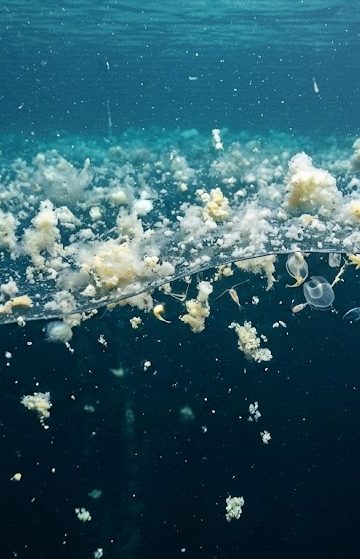
BIOPOLYMERS are long-chain molecules, such as polysaccharides and proteins, produced abundantly by algae, bacteria, and other marine organisms. Their primary environmentally relevant characteristics include:

  • high carbon storage capacity,
  • stickiness that drives aggregation into marine gels and marine snow,
  • the ability to form three-dimensional networked structures that modify rheology of water column and impart elasticity to marine systems.

Thereby biopolymers affect processes from nano-to macroscale including motility of microbes, diffusion of nutirnets, sedimentation of marine aggregates and carbon flux, gas-exchange at sea-water interface,  and turbulence characteristics.

My research centers on the dynamics of marine gels, marine snow, and pollutants, with three primary focus areas:

  • Biopolymer-mediated aggregation: Investigating how biopolymers alter physical properties and viscoelasticity of marine aggregates.
  • Biologically-modified rheology of seawater: Studying how dispersed biopolymers increase fluid viscosity and induce elasticity, thereby altering local hydrodynamic processes.
  • Sedimentation dynamics in changing ocean: Examining physics of marine particle accumulation in stratified waters and biopolymer-rich layers generated by intense algal blooms.

Gemini generated

Non-Newtonian hydrodynamics in EPS-rich systems

Exopolymers (EPS) secreted primarily by algae and bacteria modify the mechanical properties of water. EPS-rich regions are more viscous than the surrounding water and often exhibit non-Newtonian, viscoelastic behavior, shifting local hydrodynamics away from the Newtonian regime. Consequently, particles sinking in EPS-rich water experience enhanced drag, viscoelasticity-induced reorientation, and altered wake structures and velocity fields.

Particle hydrodynamics in EPS-rich systems is an emerging research area that contributes to understanding particulate matter dynamics in regions affected by algal blooms. This interdisciplinary field integrates physics, chemistry, and biology, and its relevance extends to industrial applications where EPS are used as rheology modifiers.

Spheres (diameter = 5 mm) sinking in doublet in EPS-rich water, PIV measurement

Particle motion in stratified fluid

Density stratification in seas and lakes, driven by salinity and temperature gradients, strongly affects sedimentation processes. Organic aggregates and other biogeochemically relevant particles, including faecal pellets, minerals, and pollutants such as microplastics, experience buoyancy effects that reduce sinking velocities, alter orientation, and promote aggregation. Stratified layers often become hotspots for organic matter and plankton, forming thin layers or mucilage mats. Particle hydrodynamics in stratified aquatic systems is a rapidly growing field that advances our understanding of  microscale processes, biogeochemical cycling, and sedimentation dynamics. Relevance of basic physical processess in stratified systems extend to the atmosphere and industrial systems.

Disks settling in density-stratified water with visualised wakes, licensed under a Creative Commons Attribution 4.0 International License, http://creativecommons.org/licenses/by/4.0/ source: Fig. 3, Mrokowska, M.M. Stratification-induced reorientation of disk settling through ambient density transition. Sci Rep 8, 412 (2018). https://doi.org/10.1038/s41598-017-18654-7

Contact

Magdalena Mrokowska PhD, DSc

Institute of Geophysics, Polish Academy of Sciences

Ks. Janusza 64, 01-452 Warsaw, POLAND

  • LinkedIn
  • X

ResearchGate

  • Mail

Blog at WordPress.com.

Texts and images in this blog are licensed under CC BY-NC-SA 4.0 unless otherwise stated

  • Subscribe Subscribed
    • Magdalena Mrokowska - biogeophysics | soft matter in hydro-environment
    • Already have a WordPress.com account? Log in now.
    • Magdalena Mrokowska - biogeophysics | soft matter in hydro-environment
    • Subscribe Subscribed
    • Sign up
    • Log in
    • Report this content
    • View site in Reader
    • Manage subscriptions
    • Collapse this bar