Marine gels
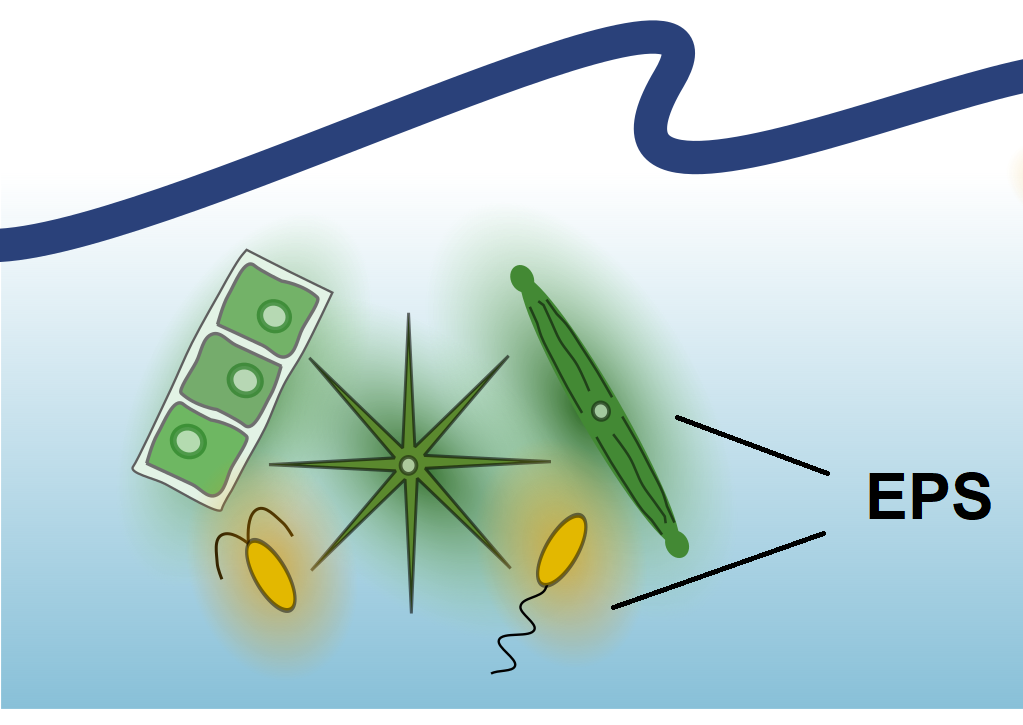
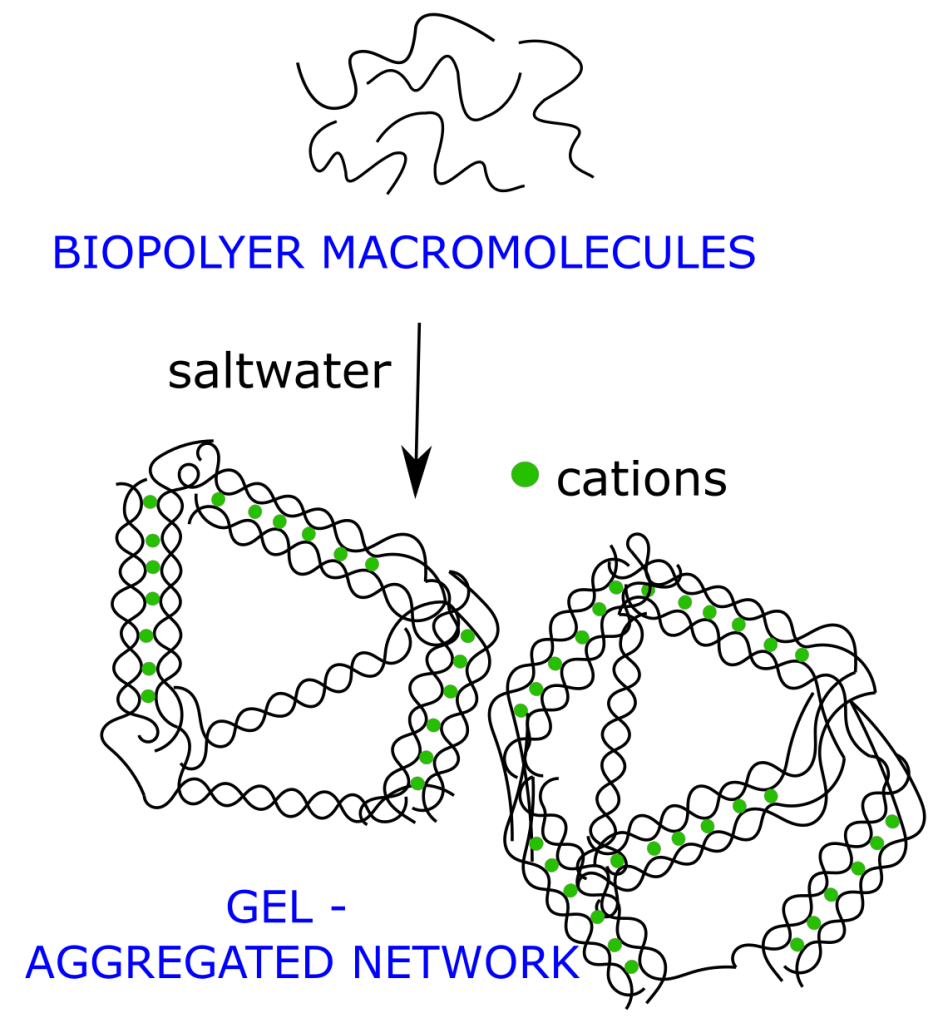
Gels are 3D matrices composed of networked polymer macromolecules and retaining high volumes of liquid. Marine gels are formed by biopolymers—such as polysaccharides and proteins—released by algae, bacteria, and other organisms into the surrounding water (thus called exopolymers, EPS). Biopolymers are sticky, which means they easily bind into aggregates. This process is facilitated with weak physcial interactions including electrostatic interactions, van der Waals forces, hydrogen bonds, and hydrophobic interactions, and occur across a wide range of sizes. Dissolved or colloidal EPS molecules can associate into micron-scale Transparent Exopolymer Particles, centimetre-scale marine snow, and even larger macroaggregates. Their inherent stickiness promotes aggregation with other particles, facilitating the formation of mixed agglomerates containing algae, bacteria, mineral grains, and pollutants. Gels may appear as discrete, sparsely distributed particles in otherwise “clear” water, or they may occupy large volumes, transforming the environment into a mucus-rich medium, as often observed during intense algal blooms.
Algae modify physics of water
Algae and associated bacteria produce biopolymers that are secreted into surrounding water (exopolymers, EPS). When these exopolymers accumulate in excess, natural water becomes thicker (more viscous) and may gain elasticity. Physically, it may shift from a Newtonian to a non-Newtonian medium.
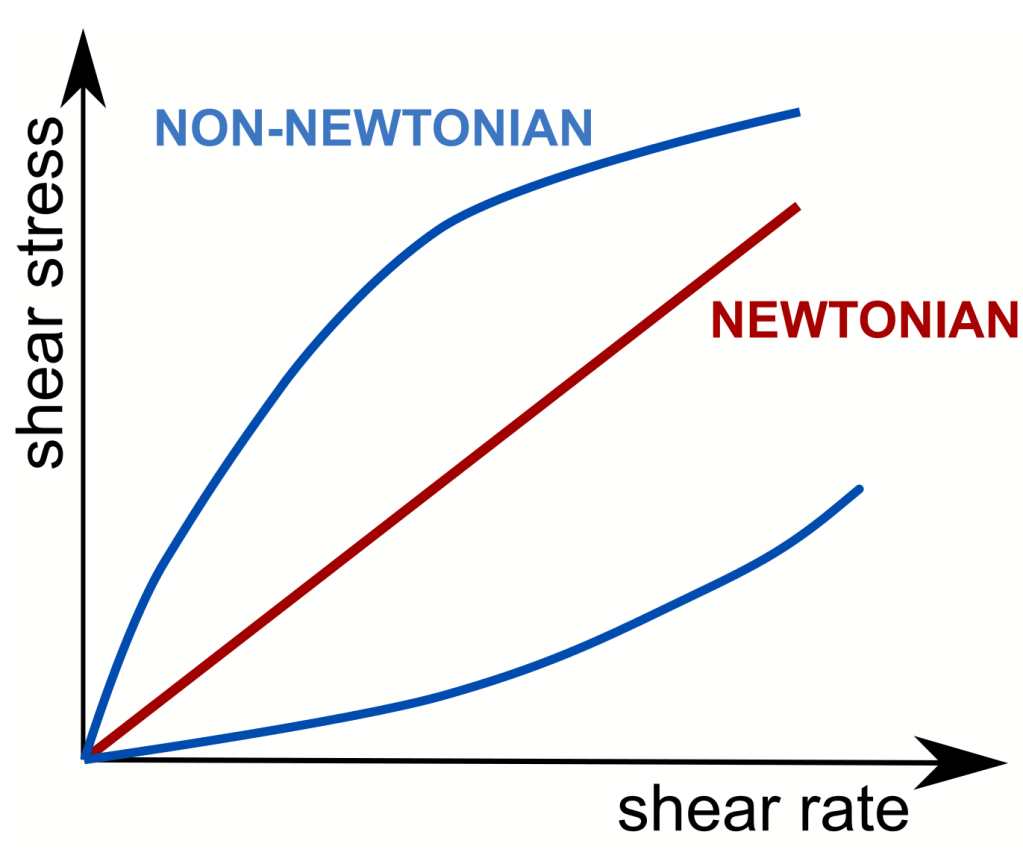
Rheology—the study of material deformation and flow, distinguishes these behaviours. In Newtonian viscous flow, shear stress (a force acting parallel to a surface) is proportional to shear rate (the rate of deformation) through a constant viscosity that reflects the fluid’s internal resistance. In EPS-rich, non-Newtonian water, this proportionality breaks down: viscosity changes with increasing shear because the exopolymer network undergoes structural rearrangements. In addition, mucus-rich water acquires solid-like properties expressed as elasticity; together, its liquid- and solid-like responses define its viscoelasticity. Through these mechanisms, microorganisms fundamentally alter the rheology of water, imparting non-Newtonian characteristics that significantly modify the microscale physics underlying environmental processes.
Pycnocline as bottleneck for carbon and pollutants transport
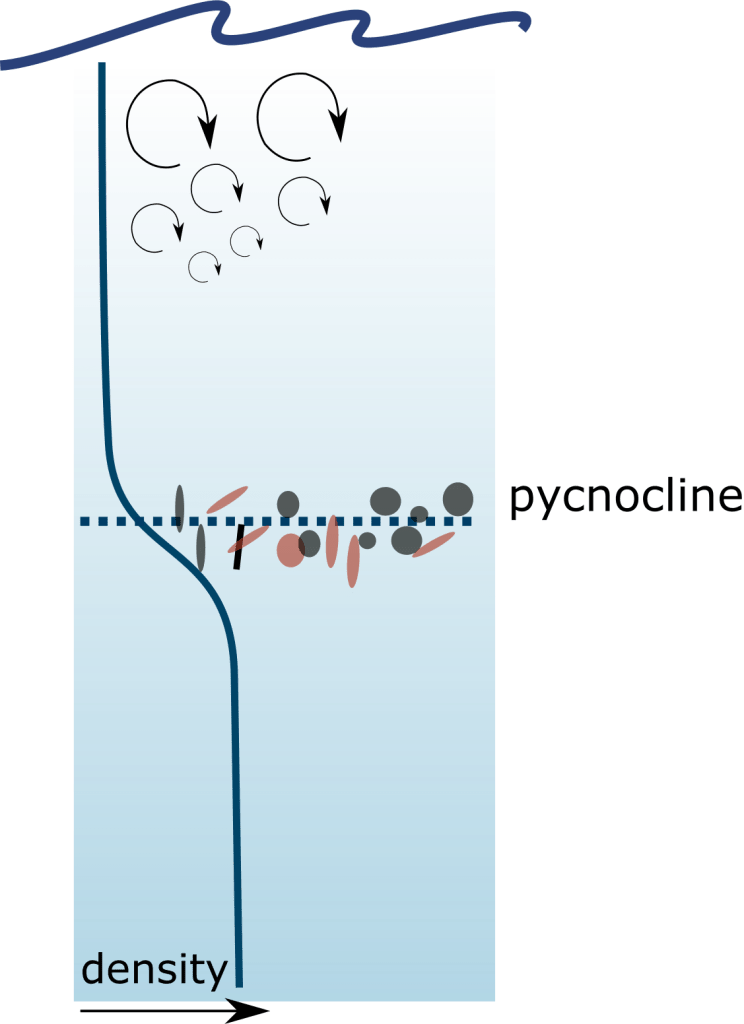
Marine waters are stratified by vertical density gradients. Sharp density transitions, known as pycnoclines, are primarily driven by variations in salinity (haloclines) or temperature (thermoclines). This phenomenon is particularly pronounced in restricted or semi-enclosed aquatic environments such as fjords, estuaries, sinkholes, and some seas. Pycnoclines significantly influence the transport and fate of marine particles. As particles sink, the sharp increase in water density combined with stratification-induced drag reduces their settling velocity, causing non-intuitive settling dynamics and increased residence time at the pycnocline (DOI: 10.1038/s41598-017-18654-7, DOI:10.1038/s41598-020-77682-y, DOI:10.1007/s11600-020-00455-8). This physical barrier leads to the formation of concentrated thin layers of phytoplankton, organic debris, and other suspended matter.
The formation of these thin layers has critical ecological and biogeochemical implications for accumulation of pollutants such as nano- and microplastics. Importantly, delayed downward transport of organic matter hinders the biological carbon pump.